DAISHO:
The following article by Darcy Brockbank explains Daisho thoroughly and is reproduced here with permission. The article was written in 2017, as such the number of “Daisho Token” may have changed, but the information has not.
By Darcy Brockbank (1969-2022)
A nice to have on everyone’s list… the daisho. The name literally means
“big-small” and refers to the pair of swords that only a samurai was
authorized to wear.
There are some simple basics about daisho and some misconceptions. The
learning curve is shallow but some people skip over the essentials, and it can
cause some damage.
KOSHIRAE
The first and most salient point is that daisho are about the koshirae. It does
not matter what swords you put into a daisho, but once you have matching
koshirae, you have yourself a daisho. The katana might be Kamakura period
and the wakizashi might be Shinshinto, with 6 centuries difference in time,
but they are still a daisho once they go into matching koshirae.
Lose the koshirae and you have two independent swords again.
Keeping with this thought that daisho are a koshirae thing, you can have
daisho tsuba, daisho fuchigashira, daisho menuki and even a full set of daisho
tosogu that have all the parts you need to create mounts for two blades.
People have a misconception that daisho were usually swords made as pairs,
and this does not bear out when we examine the NBTHK Juyo Token records.
Rather we see evidence that these swords were all mixed and matched. The
reasons for this are:
- Some lords provided a single sword to their samurai and he was expected to
provide the other, so they got sourced from different supply. - Desirability of a sword for use is highly individual, if you had a katana you
really loved you might test several wakizashi to find one that you also really
loved, in order to mount together. Love might be synonymous to “this blade
feels great in my hand, and I feel good about defending my life with it.” What
you may like out of one maker’s katana you may not be interested in with
their wakizashi. - Koto wakizashi from earlier than Muromachi might not be easily accessible
as they usually depend on making a tachi suriage (unless you use a hirazukuri
wakizashi or a naginata naoshi). So this makes matching a koto katana
difficult. - Some swords were assembled by theme as gifts, such as giving a Yukimitsu
wakizashi along with a Masamune katana, to or from the Shogunate. In this
case obviously some thought went into this to make the blades both Soshu
school and with smiths that had a close relationship. But these seem to have
been done like this more frequently than to match both blades together by the
same maker. - You could break one sword and then you’d get a replacement which you
could afford, you liked, and you felt could defend your life, and the last item
of worry would be matching the “swordsmith brand” of your other unbroken
blade.
There are however some swords that were made as a pair. These are very rare.
DAISHO TOKEN
Everyone tries this at some point, we try to get two matched blades by the
same maker, so we can have our own daisho. These blades sometimes have
passed their papers at different times, and we take this and construct mounts,
find some matching tsuba and fuchigashira and boom, we have a daisho.
It’s not a true daisho.
True daisho were used by samurai in the Edo period. Unless you are a
samurai with a time machine, what you just made is not a true daisho. At best,
these… are what I call self-assembled daisho. Or an assembly. We can
colloquially call them daisho but the important thing is to not mix them up
with historical daisho.
They are just expressions of a collector showing some love for his swords and
assembling them so that he has something that makes him happy.
Sometimes a collector looks carefully and finds two blades with similar
signatures by the same maker, and well matching styles and submits them
together to try to get a very rare paper.
DAISHO TOKEN
This paper is the daisho token paper and it is almost never awarded. Because
the NBTHK knows we submit blades we’d like to be daisho in our
fantasies, and they examine very carefully these blades and find discrepancies
and so pass them on different papers, though they were submitted as daisho.
I got it once on an unusual mumei Shinshinto pair of swords attributed to
Ozaki Takashige. This is not a high level smith, and the blades being mumei
shinshinto were not high level blades. But they were real daisho token, made
at the same time, by the same smith, intended as a pair.
For your reference, this is the paper I got (take note, it’s rare):
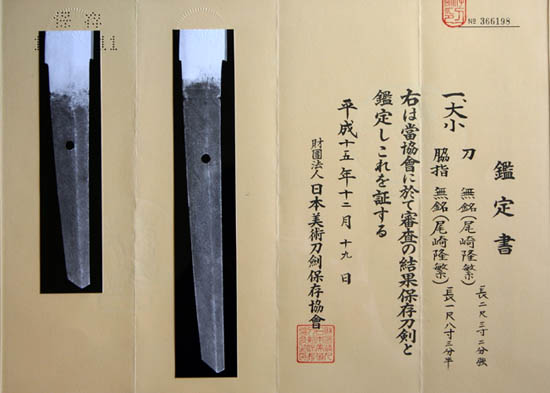
You can see both blades are on the same paper. The Japanese heading says:
一大小 (One Daisho) and then under this heading describes the katana and
Wakizashi as both being unsigned by Ozaki Takashige.
This is an important thing, because a lot of swords are sold as a daisho… and
then have two papers. Well, that means it’s not a daisho by any stretch unless
they are in matching historical mounts.
True daisho token are hard to get, because they were almost never made in
the first place… and those made were damaged, lost, mixed up and so on.
Now 99.99% of the time people try to get a daishi token paper it doesn’t
happen and it just comes back with two separate papers. This doesn’t mean
that the swords do not belong to a daisho. It just means that the swords
themselves are not a daisho.
Daisho tsuba are still daisho tsuba even though you take them off of the
mounts, however daisho swords lose their status unless they were made
together: all the other tosogu items were made together so they retain their
daisho status.
Being a daisho themselves for swords means that the swords need to be made
on the same day by the same smith with the intention of being a mated pair.
Same as tosogu, it’s just that while it is common for tosogu it is not common
for swords, as it wasn’t a requirement.
What matters here is the intent.
On a wakizashi you found on eBay and a katana sold to you by your friend,
even if they look like they match, these are not daisho token by the
classification that gets them onto one paper. There was no intent of the maker
of those blades to mate them together. Hence, they are not daisho token.
HISTORICAL DAISHO
In a historical daisho, it doesn’t matter if your sho is a tanto or a naginata
naoshi, or your katana is a naginata naoshi and your sho is a shinto wakizashi:
if they go into Edo period koshirae and did so in the Edo period, then they
are part of an Edo period daisho. The swords are not daisho token but they
are part of a daisho.
Burn the daisho koshirae: you are left with two unrelated swords.
Secondarily, if that daisho koshirae is not Edo period, and the assembly itself
is not Edo period, then it is not a true daisho. It’s a collector’s hobby project
daisho. An assembly.
True daisho koshirae from the Edo period are hard to find, and those of high
quality pass Juyo on their own. If the NBTHK accepted them into papers, it
means the NBTHK thinks they are Edo period daisho koshirae and not slap
togethers from 1978.
PRE-SHINTO SWORDS IN DAISHO
Daisho is a concept that begins to be formalized in the Muromachi period
with Oda Nobunaga’s conquest of Japan and under the Tokugawa is
formalized as a badge of office for samurai.
So, no koto smiths we know of made daisho token explicitly. Samurai did not
exist at the time of the koto smiths, nor did this wearing of the sword pair
exist as a badge of office, nor was it even a common pattern to wear a katana
and wakizashi together both edge up in matching koshirae.
It would be far more likely that a Muromachi bushi would have a yari and
small katana or large tanto as a backup. But it’s likely that these warriors
armed themselves as the case required it based on what their mission was. So
no koto pair of swords today will be accepted onto one paper as daisho
token basically because they predate the concept. They can be united later
into a daisho by being chosen in the Edo period and mounted in purpose
made mounts. Now they are part of a historical daisho.
It’s up to you to use your thinking cap to see what you’re dealing with, as a
self-assembled daisho has no particular historical value other than it can be
two nice swords and some nice mounts. So, no bonus value for you as a
collector other than how you feel about those mounts aesthetically. Whereas a
historical daisho is something that is rare and very nice to have as it is a hard
to acquire artifact of the Edo period. The more parts in the set = the more rare
the set.
DAISHO TOKEN REVISITED
When it comes then to who made daisho token the first thing we learn about
them is that chiefly they are a Shinshinto thing. The idea of making swords as
explicit pairs did exist in the Shinto period but it doesn’t appear to be very
common. In the Shinshinto period it seems to have come into vogue then to
place orders with one smith for a fully matched pair of blades. Even so, that
in itself was not so common when we look at the Juyo results.
By my count there are only 23 daisho token that have passed Juyo, compared
to 11,422 swords as of the time of this writing. So, the number immediately
must strike you as miniscule.
The earliest daisho token that the NBTHK made Juyo is a Mizuta Kunishige
pair of swords.
These swords have identical mei on both sides and from the horimono it’s
clear they are a matched pair. When these blades pass Juyo, they pass as a set:
this is a Juyo Daisho Token. The katana is Juyo and the Wakizashi is Juyo,
but they are together an inalterable set.
This can in rare instances happen with the koshirae intact as well.
The next earliest daisho that passed is a Shodai Tadayoshi work signed under
his second name Musashi Daijo Tadahiro. During this time, almost a pre-
retirement, he made some interesting special orders and many high quality
blades. This daisho is again identically signed, and also dated, as well as
having hamon that clearly were made to go together, so the NBTHK accepted
them as Juyo Daisho Token. Note the right column, indicating a daisho and
then conjoining katana and wakizashi.
If your daisho swords are not coming on one paper like this — they are not
daisho swords (daisho token). Again, I note this doesn’t make them not a
component of a daisho. As long as they reside in Edo period
daisho koshirae, then they are part of a daisho. And, in that case as well, they
do not have to even be made by the same maker. Because, this almost never
happened and it is how it was.
Daisho token are their own special thing in and above being components of a
daisho. This is why they can paper on their own.
If the total of 23 times that this has happened in NBTHK history, that daisho
token have passed Juyo, only seven of those belong outright to the Shinto
period.
- Mizuta Kunishige
- Hizen Tadayoshi (Musashi Daijo Tadahiro)
- Izumi no Kami Kunisada (nidai, aka Shinkai)
- Tatara Nagauki
- Nobukuni Shigekane
- Tango no Kami Kanemichi (Nidai)
- Tegarayama Masashige
That’s all. There is no doubt that there are more made and their mates lost, or
both blades lost to time, and there are more that will come later. But of
11,000 blades passing Juyo so far, you need to understand there are only 7
Juyo Daisho Token from the Shinto period.
SHINSHINTO DAISHO TOKEN
It’s a lot harder for Shinshinto blades to pass Juyo than it is for Shinto, and
Shinto it’s harder than for Koto. Shinshinto is especially difficult (read it
as impossible) to pass Tokuju. Only once has a Shinshinto item passed
Tokuju and this is a daisho by Kiyomaro. So, if you want to crown one item
Shinshinto King, that would be the item you would want to pick.
In spite of this now we see that the majority of daisho passing Juyo belongs to
this period. The hardest period to get Juyo. The implication then is that daisho
token do not exist from the koto period… and are a rarity in the Shinto period
then it becomes an item of interest in the Shinshinto period. We see the
following smiths represented:
- Kiymaro (3 sets, one as Masayuki)
- Korekazu (2 sets)
- Suishinshi Masahide (2 sets)
- Hosokawa Masayoshi
- Koyama Munetsugu (4 sets)
- Taikei Naotane (3 sets)
- Ozaki Suketaka
- Tsunatoshi
- Sa Yukihide (2 sets)
So, that’s it. Those are all the Juyo daisho token. The only other one I’ve seen
papered to daisho token is the Takashige of mine above (he’s a student of
Suketaka on this list).
WHAT YOU NEED TO LEARN FROM THIS
True daisho token are extremely rare. It’s one of the rarest things out there. If
you stumble into one of these, they will always be on the same paper, and
the paper will make a point of saying it’s a daisho. Acquiring such a thing
should be a no-brainer, since so few people can own a matched pair of swords
by the same swordsmith intended as a set. I really have to hammer on that
point. Without the smith’s intent, those swords are not a true daisho on their
own.
This doesn’t mean they are not interesting. This doesn’t mean it’s not fun and
interesting to find and put together your own daisho blades. In fact it is highly
rewarding to think of reuniting long lost brothers from the same forge, and
finding nice tosogu to mount them up.
Especially since so few people will ever get to own daisho token this is
something collectors often indulge themselves in and I encourage people to
do it.
As a buyer though you need to know the difference between these self-
assembled sets and the real things.
SWORD AND KOSHIRAE RELATIONSHIPS
When the NBTHK welds a koshirae to a sword as a historical set, the
koshirae may or may not be photographed on the same paper, but they
are listed on the same paper. Lacking that note, the NBTHK has not stepped
in to judge them as a set together. The owner may have omitted the koshirae
for submission (often happens, especially if the owner thinks the sword is
much higher level than the koshirae) or the NBTHK didn’t accept them at
Juyo, or maybe they didn’t exist and are later creations of a collector. We
don’t know what the situation was exactly if the koshirae are not on the paper.
This is more common than anything that koshirae are not noted.
But we know if the koshirae are on the paper, it means the NBTHK accepted
them as a set with the sword. This is more rare, and I call these ensembles.
DAISHO FITTINGS
Daisho fittings exist in much greater quantities than daisho token, because it
was clear that swords being made by the same maker was not a key element
for samurai of the Edo period, but was possibly a nice gift or a fashionable
thing to do at the end of the Edo period. As such, you should concentrate
yourself on the fittings.
Individual daisho tosogu we encounter all the time and these paper together
all the time as well. An example can be seen here of a daisho fuchigashira
from Tomei that I papered.
You can see again the word 大小 (daisho) mentioned in the long column.
And all items are photographed on the same paper. If you get two
fuchigashira with two different papers, you have a self-assembled set for your
daisho.
If you are considering daisho koshirae, they also should be papered on the
same papers. There is a weird exception to this which I will get to at another
time, which is the case where two koto swords housed in daisho koshirae go
into Juyo together and the entire set, all items, all pass Juyo in the same
session. In this case you have two Juyo swords, components in a Juyo set of
koshirae.
Because the swords are not made together (as above, we don’t see koto
daisho made as a set, daisho is an Edo concept)… and since both swords both
passed Juyo, they have to go onto different papers. The koshirae that unite the
two blades then will be split and placed with each blade. This is so rare
though that I know of it happening only one time so far.
If there are no papers for the koshirae, and it is claimed as an antique daisho
you really need to do your homework to see what you’re dealing with.
HISTORICAL SETS
Swords and tosogu that were historical sets should generally:
- match in polish
- match in shirasaya
- be papered at the same time, or at times that make sense
If I have menuki papered in 1978 and clearly not under a tsuka wrap in the
photos, and I have tsuba papered in 1985, and a katana with 1969 papers and
a wakizashi with 1993 papers, the katana is in an old shirasaya with Honma
sensei sayagaki and the wakizashi in a new shirasaya with Tanobe sensei
sayagaki and these are all together now under daisho mounts… well you
should draw a fair conclusion from what you’re looking at. I hope you can if
you read this far.
Common sense counts for a lot. People abandon it too frequently.
This evidence is most reasonably explained by a collector picking up items as
he finds them, items he likes, items he thinks can match, and then finally after
a long time putting together his daisho.
There is nothing wrong with these at all and they can be very attractive sets.
Someone put them together for this reason, out of pride and love. But you as
a buyer need always to understand if you’re looking at something historical or
something that is a collector’s work.
Daisho koshirae will come on the same paper, and you should look carefully
at the photos and descriptions and make sure that nobody swapped
parts: kozuka get lost all the time and someone replaces them after they get
papered. Now, you buy it and you didn’t look closely, and find out that your
kozuka on your set is not the one in the photo. It’s happened to me, and it’s
happened on koshirae that was offered to sale to me by other dealers that they
swapped the kozuka but didn’t tell me. Just left it for me to check the papers
and go over my head or not.
Now, if you end up in this you have a broken set and it’s too late to do
anything about that.
When you buy a legitimate papered daisho from the Edo period you are
getting a historical artifact. Something that was worn by a samurai or a
daimyo. Full matching koshirae are hard to find as many of them just wore
out and many were disassembled.
When we reassemble a koshirae usually it ends up being many pieces with
their own papers. I do it, others do it, there is nothing wrong with it, it’s what
you do to make a koshirae. If you see 4 different papers and 4 different dates,
you need to know what you’re looking at and separate it from the historical
pieces.
Good daisho koshirae that passed Juyo are also rare: there are 82 daisho
koshirae by my count. Some small number of those have fairly
inconsequential swords in them.
BUYING SKEPTICISM VS. OWNING CONSERVATION
If a seller is not making a claim that a set is a historical set, and there is no
active reason to look at a set and believe it is a historical set, then you should
set your brain accordingly. Be skeptical.
However: you should always give it the benefit of the doubt when you own it.
Don’t start taking them apart and swapping components unless you know for
sure that this is OK to do, because you can possibly make a passable situation
or a good situation that is just not documented, worse. But your skepticism as
a buyer, and an owner, are on different sides of the fence.
I wrote recently: treat every gun as if it’s loaded is good advice for owners of
sets of components. You may not have the provenance and none of it is
papered, but you should treat it as if it has provenance that is lost. Don’t make
a bad situation worse by playing games with the components.
I once had a koshirae that was entirely Mino Goto mounts of nice quality
except the tsuba was a Higo tsuba. It was a style mismatch and it meant to me
that someone lost the tsuba and just slapped on one that fit. The tsuba was
nice. But I bought a Mino Goto tsuba that matched all of the other tosogu in
style, and put it on there. That fixed the koshirae and made it match in style.
When I sold it, I sold it with two tsuba and the owner has the information and
what I did to it, so that he can preserve it according to his information. In this
case, I felt good about resolving the style mismatch and I didn’t destroy
anything in doing so.
As a buyer, you should remain skeptical about provenance unless there is
reason presented to you that pursuades you to believe it. If a set has nothing
to say about why it seems historical, just don’t give it any bonus allocation in
funding as a buyer. Once you own it, treat it with great respect and don’t
break it up because someone said on the internet that you can’t prove it was
meant to be together.
If you can prove that the items don’t belong together, that’s another story. At
this point you are free to do what you want.
CONCLUSION
Daisho added to any component, makes everything more rare. Even an
assembly in the modern period means someone has brought together some
sets of matching tosogu and these can be quite nice to have.
Daisho Token are the holy grail for sword collectors, and daisho koshirae are
a wonderful rare item for tosogu collectors, and nobody ever looked down on
a daisho tsuba or any other piece of fittings.
Always break down and examine what you’re looking at because at face
value you may just assume that all of this is a historical artifact and it is not
always the case. So, know what you are dealing with.
This does go true for koshirae and single swords as well. Koshirae got mixed
and matched frequently and it can be hard sometimes to know if any one
koshirae belongs to a sword forever. We can make educated guesses and we
can prove in some cases that a koshirae is a remount by examining it.
Sometimes some faith or a balance of probabilities is necessary to judge some
of these things.
In which case, it is nice to have an expert opinion in writing. Like on a Juyo
paper.